Walter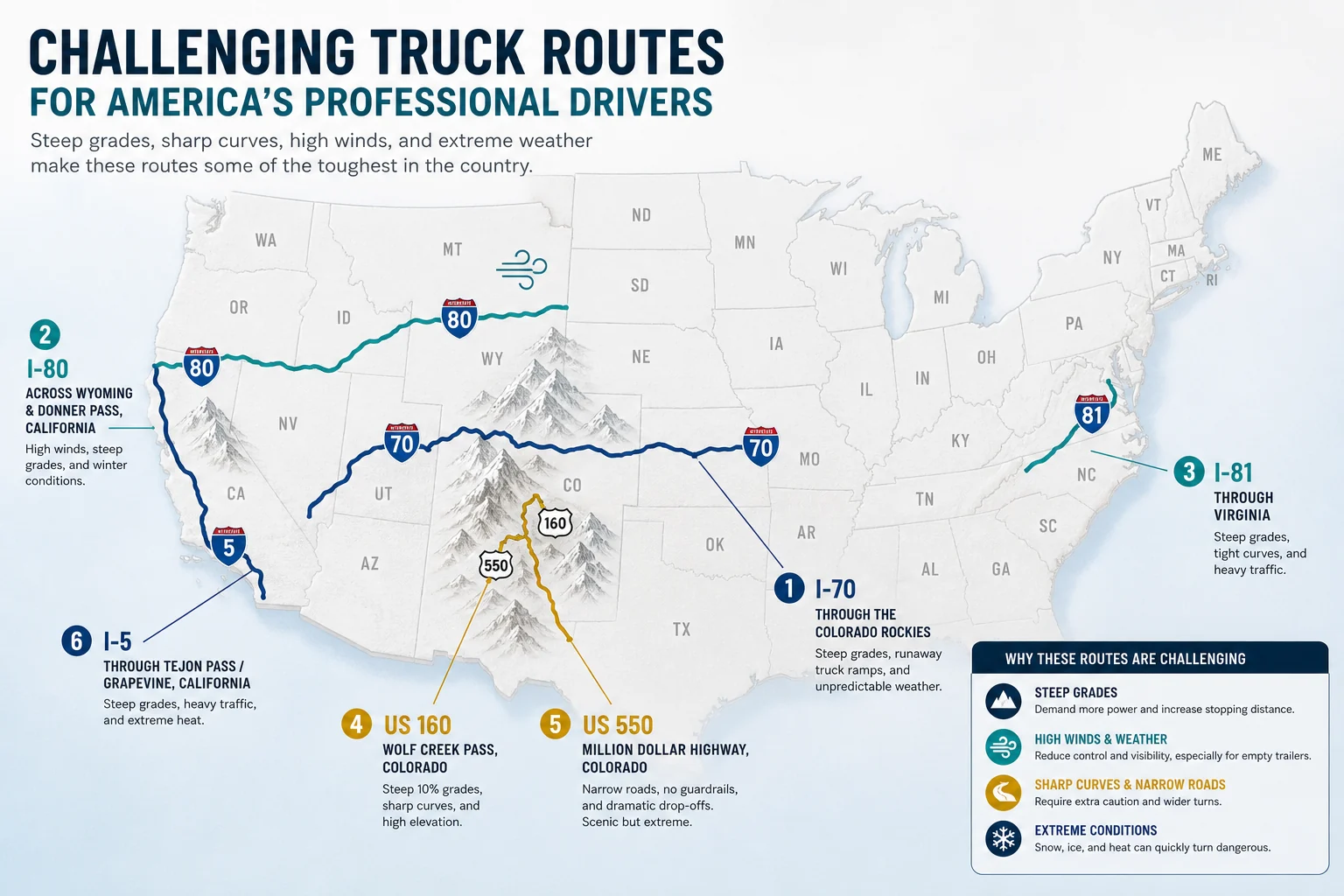
Driving a semi-truck anywhere requires concentration, but some American highways demand significantly more from a professional driver than others. Steep mountain grades, sharp curves, extreme crosswinds, heavy snow, limited visibility, dense truck traffic, and long downhill sections can turn an ordinary freight route into a serious challenge.
A road that is relatively easy in a passenger car can feel completely different in an 80,000-pound tractor-trailer. A heavy truck takes longer to stop, gains speed rapidly on downhill grades, is more vulnerable to crosswinds, and needs much more room for curves and emergency maneuvers.
There is no single official federal ranking of America's "most dangerous roads for truck drivers." Crash rates also change from year to year. Instead, this article focuses on routes that present well-documented trucking hazards such as steep grades, severe winter weather, high winds, heavy commercial traffic, and difficult mountain terrain.
Some of these highways are major freight corridors that experienced OTR drivers travel regularly. Others are routes where a driver should be especially careful before accepting a load or following GPS directions.
Here are some of the most challenging roads for truck drivers in the United States.
What Makes a Road Dangerous for a Semi-Truck?
Dangerous trucking roads are not always the highways with the most curves or the highest mountains. Risk usually comes from several factors appearing at the same time.
A steep grade becomes much more dangerous when it is combined with ice. A windy highway becomes more serious when the trailer is empty. Heavy traffic becomes more difficult when large trucks make up a significant percentage of the vehicles on the road. A mountain descent becomes dangerous when a driver enters it too fast or begins relying excessively on the service brakes.
Weather is one of the biggest variables. Mountain highways can change from dry pavement to snow or ice in a short period of time. High-elevation routes may require chains, and roads through open parts of the West can experience crosswinds powerful enough to overturn high-profile vehicles.
Terrain is equally important. On a long downhill grade, a loaded tractor-trailer continuously gains energy. Riding the service brakes can cause excessive heat and eventually reduce braking effectiveness. The driver needs to select an appropriate gear and speed before beginning the descent rather than trying to correct excessive speed halfway down the mountain.
Then there is traffic. Some Interstate corridors carry enormous numbers of trucks every day. When high commercial traffic combines with construction, narrow lanes, congestion, and limited opportunities to avoid an incident, the consequences of one crash can be severe.
Professional drivers therefore need to think beyond the question, "Is this road legal for trucks?"
A better question is:
What conditions will I face on this road today, with this truck, this load, and this weather?
1. Interstate 70 Through the Colorado Rockies
Few major freight routes demonstrate the challenges of mountain trucking as clearly as Interstate 70 through Colorado.
I-70 is an essential east-west highway, but west of Denver it climbs into the Rocky Mountains and passes through areas including Georgetown, the Eisenhower-Johnson Memorial Tunnels, Silverthorne, Vail Pass, and Glenwood Canyon.
For a truck driver, this means long climbs, long descents, changing weather, high elevations, heavy traffic, tight mountain terrain, and winter conditions that can develop quickly.
Colorado DOT specifically identifies several challenging areas along the I-70 Mountain Corridor. Around Georgetown and Silver Plume, CDOT notes steep grades that contribute to congestion. Other locations combine difficult weather, curves, traffic volume, and roadway geometry.
Winter adds another level of difficulty.
Colorado requires commercial drivers traveling I-70 between Morrison and Dotsero to carry chains from September 1 through May 31. Chain requirements may then be activated when weather and roadway conditions require them.
For a driver unfamiliar with mountain routes, the biggest mistake is approaching a descent at highway speed and assuming the brakes will control everything.
They may not.
A loaded truck should enter a long downgrade at an appropriate speed and gear. Engine braking can help control speed, but drivers still need to understand the specific truck, load, grade, road conditions, and company procedures.
Weather is another reason not to become overconfident on I-70. CDOT warned again in April 2026 that the mountain corridor can change from dry pavement to ice within minutes during Colorado's unpredictable spring storms.
For experienced mountain drivers, I-70 may be routine.
For a new CDL driver seeing Vail Pass during a snowstorm for the first time, it can be one of the most demanding routes in the country.
2. Interstate 80 Across Wyoming
If Colorado is famous for mountain grades, Wyoming's Interstate 80 is famous for wind.
The highway crosses a large, open portion of southern Wyoming and is one of the most important freight corridors between the Midwest and western United States. Trucks use it constantly, but weather can make the road extremely challenging.
High-profile vehicles such as dry vans and reefers can be especially vulnerable to powerful crosswinds.
An empty 53-foot trailer may weigh much less than a loaded one while presenting almost the same enormous side area to the wind. That makes empty and lightly loaded trailers particularly sensitive to strong gusts.
Wyoming DOT has used restrictions for light and high-profile vehicles for years and introduced a weight-based wind closure system in 2023. The state specifically warns that Wyoming winds can create an extreme blow-over risk.
The crash statistics show why drivers need to take those warnings seriously.
WYDOT recorded 83 blow-over crashes in 2024, and heavy trucks over 26,000 pounds accounted for about 41 percent of the vehicles involved. The state notes that I-80 and I-25 are the major corridors where many wind-related rollovers occur.
More recently, a severe March 2026 wind event produced as many as 32 blow-over crashes across Wyoming in one day. Up to 12 occurred on I-80 between Laramie and Arlington, and wind gusts reached as high as 109 mph in the state. WYDOT closed some highway sections to trucks and trailers during the event.
That is why a driver should never interpret a wind restriction as a suggestion.
If WYDOT says your truck or weight class is not permitted to travel, wait.
Being late for a delivery is inconvenient.
Having a trailer blown onto its side at highway speed is much worse.
3. Interstate 80 Over Donner Pass, California
The same Interstate 80 presents an entirely different challenge when it reaches the Sierra Nevada and crosses Donner Pass between California and Nevada.
This section connects Sacramento with Reno and carries substantial commercial traffic, but winter storms can produce heavy snow, ice, chain controls, closures, and significant delays.
Caltrans specifically identifies Interstate 80 over Donner Pass as one of the California routes where chains are commonly required. During severe conditions, heavy trucks can be required to use link-type chains, and Caltrans may establish truck-screening checkpoints before allowing commercial vehicles to continue into the mountains.
Truck screening is important because there may not be safe space for an unprepared tractor-trailer to simply park once it reaches higher elevations.
Caltrans can turn trucks around if they do not have the required chains. During particularly difficult conditions, truck-trailer combinations may also be held or turned around because of traction problems over the summit.
The descent presents its own challenge.
Snow is not the only thing a driver needs to think about on Donner. Braking technique, speed, traffic congestion, visibility, and rapidly changing conditions all matter.
Before entering the Sierra during winter, drivers should check current Caltrans conditions, verify that the required chains are onboard, understand how to install them, and have enough fuel and supplies to handle a significant delay.
A road that looks manageable when leaving Sacramento can become completely different by the time the truck reaches higher elevation.
4. US 160 Over Wolf Creek Pass, Colorado
Wolf Creek Pass on US Highway 160 deserves special attention because Colorado DOT has created truck-specific safety information for the route.
The west side of the pass includes a 7 percent downhill grade, and the descent continues for more than eight miles from the summit toward the base near Treasure Falls. CDOT also warns drivers about a dangerous hairpin curve approximately six and a half miles from the summit.
For westbound commercial vehicles, the posted maximum speed on the downhill section is 25 mph.
That alone should tell drivers this is not an ordinary highway descent.
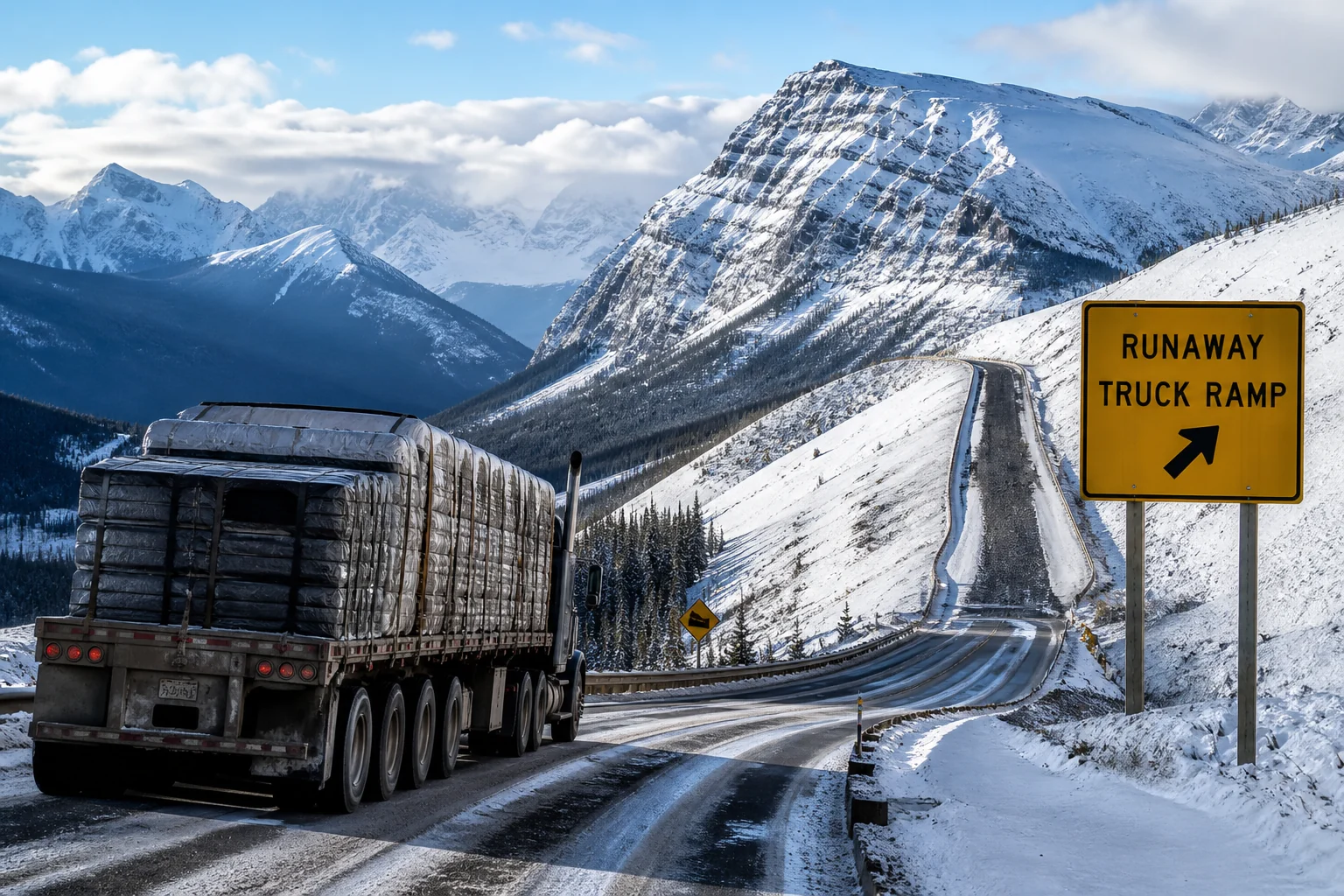
The pass also contains two runaway truck ramps on its western side. The second is the final opportunity for an out-of-control truck to use an escape ramp before continuing toward the bottom.
A driver approaching Wolf Creek should not wait until the descent begins to think about braking.
CDOT specifically advises commercial drivers to inspect brakes before descending, maintain a low speed and low gear, avoid riding the brakes, and use engine braking appropriately while maintaining control.
This is particularly important for new drivers.
On a long downgrade, riding the service brakes can generate enormous heat. If the brakes become too hot and braking effectiveness begins to fade, the truck may be moving too quickly for the driver to recover using ordinary methods.
Experienced mountain drivers choose their speed before the grade becomes dangerous.
Wolf Creek Pass is an excellent example of why.
5. US 550 and the Million Dollar Highway in Colorado
Another Colorado route that deserves respect is US Highway 550 between Durango, Silverton, and Ouray, including the famous Million Dollar Highway area.
The scenery is spectacular.
For truck drivers, however, portions of US 550 involve steep mountain terrain, sharp curves, winter weather, avalanche exposure, rockfall hazards, and areas where mistakes can have serious consequences.
Red Mountain, Molas, and Coal Bank passes are all located along this general corridor.
CDOT has documented safety concerns involving commercial vehicles on parts of the route. At Cascade Curve south of Ouray, for example, the agency installed additional permanent guardrail after ongoing crashes, particularly involving commercial semi-trucks. CDOT specifically describes the southbound approach as a steep downhill grade.
Other sections present different hazards.
Red Mountain Pass has steep slopes and cliff areas where rockfall mitigation is necessary, and winter conditions can bring avalanche-control closures.
A 2025 crash south of Ouray resulted in emergency recovery operations approximately 300 feet below the highway, illustrating the extreme terrain surrounding portions of the road.
A truck driver should therefore never allow a navigation app to send a tractor-trailer onto a mountain road simply because it appears shorter.
Before using US 550 with a commercial vehicle, verify that the route is suitable and legal for your specific equipment and load, check current conditions, and understand the grades ahead.
If an alternative major truck route is available and the conditions are poor, the longer route may be the smarter one.
6. Interstate 5 Through Tejon Pass and the Grapevine, California
Interstate 5 is one of the most important trucking highways on the West Coast. Freight traveling between Southern and Northern California frequently uses it.
The section through Tejon Pass, commonly associated with the Grapevine, adds mountain terrain to an already busy freight corridor.
Truck drivers deal with sustained grades, large traffic volumes, high temperatures during summer, and winter weather that can occasionally produce snow and ice severe enough to affect operations.
Many drivers who do not know Southern California are surprised that snow can become a problem on I-5 north of Los Angeles.
Caltrans specifically includes the Grapevine and Tejon Pass in its winter preparation guidance and maintains an Operation Snowflake plan for conditions severe enough to affect or close the highway. Chain controls can also be implemented on Interstate 5 over Tejon Pass when conditions warrant.
The terrain also makes speed management important.
A heavy tractor-trailer entering a downgrade too quickly has much less room for error than a passenger vehicle. Drivers need to watch posted truck speeds, traffic, brake temperatures, following distance, and lane position.
Traffic can amplify the problem. I-5 connects major California population and freight centers, so an incident on the grade can affect a large number of vehicles very quickly.
The Grapevine may not look as intimidating as a narrow Colorado mountain road, but its combination of grades, traffic, weather, and heavy truck use demands attention.
7. Interstate 81 Through Virginia
Not every dangerous trucking route is dangerous because of snow-covered mountain passes.
Interstate 81 through Virginia demonstrates how heavy truck volume itself can create a difficult operating environment.
I-81 is one of the most important north-south freight routes in the eastern United States. It carries long-distance truck traffic between the Southeast, Mid-Atlantic, Northeast, and connections to several other major highways.
Virginia's 2026 I-81 Corridor Improvement Plan shows just how important the road is to freight.
Trucks traveling I-81 account for more than 40 percent of all Interstate truck vehicle-miles traveled in Virginia and transport more than $300 billion in goods annually along the state's 325-mile corridor. Over the previous six years, the corridor averaged roughly 2,750 crashes per year, and approximately one-third involved heavy trucks.
The problem is not simply that trucks use the road.
It is the interaction between large numbers of tractor-trailers, passenger vehicles, grades, interchanges, congestion, construction, and incidents that can block travel for long periods.
A recent VDOT safety analysis of one section found that trucks represented about 30 percent of traffic and 30 percent of crashes, but large-truck crashes were associated with greater severity. Six of nine fatalities in that particular study area involved a large truck.
For an OTR driver, I-81 therefore requires a different type of caution than Wolf Creek Pass.
The risk may come from traffic compression at the top of a hill, another truck entering a lane, sudden congestion around an incident, or limited stopping distance when traffic unexpectedly slows.
Maintaining following distance and looking far ahead becomes critical.
Which Road Is the Most Dangerous for Truck Drivers?
It depends on the truck, weather, load, season, and driver's experience.
For an empty dry van in extreme wind, I-80 through Wyoming can be particularly dangerous.
During a major winter storm, I-70 through Colorado or I-80 over Donner Pass can become more challenging.
For controlling an 80,000-pound truck on a long descent, Wolf Creek Pass demands serious mountain-driving skills.
For constant exposure to dense commercial traffic, I-81 in Virginia presents a completely different challenge.
A route can also change from relatively easy to extremely hazardous within hours.
That is why a fixed list should never replace checking real-time road and weather conditions before beginning a trip.
Why Mountain Descents Are So Dangerous for Heavy Trucks
A long downhill grade creates one of the situations where a semi-truck behaves most differently from a passenger car.
As a heavy truck descends, gravity continuously accelerates the vehicle. The heavier the combination, the more energy the driver has to control.
Simply pressing the service brakes for several miles is not the correct solution.
Continuous braking creates heat. If brake components become excessively hot, their effectiveness can decrease. Eventually, the driver may require substantially more braking effort to slow the vehicle.
Professional mountain driving therefore starts before the descent.
The driver should know how steep and long the grade is, understand where brake-check areas and runaway ramps are located, reduce speed before descending, select an appropriate gear, and use available engine braking correctly.
The exact method depends on the equipment. Modern automated transmissions and engine brakes operate differently from older manual trucks, so drivers should understand the tractor they are actually operating.
Most importantly, do not begin a downhill grade faster simply because another truck passes you.
The other truck may be lighter.
The other driver may know the road better.
Or the other driver may simply be making a bad decision.
Why High Winds Are Especially Dangerous for Empty Trailers
A loaded trailer may contain 40,000 pounds or more of freight.
An empty dry van still has approximately the same height and side area exposed to the wind, but significantly less weight holding it against the pavement.
That combination makes light and empty trailers especially vulnerable to powerful crosswinds.
The driver may first feel the truck moving within the lane or notice sudden steering corrections becoming necessary. Gusts can become stronger near open fields, gaps between hills, bridges, and areas where terrain channels the wind.
The correct response is not automatically to continue because you have driven in wind before.
Check official wind restrictions and road conditions.
If authorities restrict light or high-profile vehicles, obey the restriction. If conditions feel unsafe even when the road remains technically open, find a safe place to stop.
A delivery appointment is not worth testing how strong the next gust will be.
Winter Weather Changes Everything
Snow affects much more than traction.
It can cover lane markings, shoulders, pavement defects, and signs. Blowing snow can reduce visibility almost instantly. Ice can develop in shaded areas, on bridges, or during rapidly changing temperatures.
For truck drivers, winter also creates operational issues involving chains.
States have different requirements, and mountain corridors can have special rules. Colorado, for example, requires commercial vehicles on the I-70 mountain corridor between Morrison and Dotsero to carry chains during the designated September-through-May period. California can impose chain controls and truck screening on routes including Donner Pass.
A driver who carries chains but has never practiced installing them may discover that learning on the side of a mountain during a snowstorm is extremely difficult.
Know how your equipment works before you need it.
Never Blindly Trust GPS on Mountain Roads
Modern truck GPS systems are extremely useful, but they are not a substitute for professional route planning.
This becomes especially important in mountainous regions.
A navigation system may identify a route that technically connects two towns but does not understand every temporary restriction, weather condition, construction issue, or operational concern affecting your truck.
Ordinary passenger-car GPS is even more dangerous for commercial route planning because it may not account for truck restrictions, weight limits, height restrictions, or roads inappropriate for a 70-foot combination.
Before entering an unfamiliar mountain route, check:
- Whether commercial vehicles are permitted.
- Vehicle and weight restrictions.
- Current weather.
- Chain requirements.
- Road closures.
- Grade information.
- Truck warnings.
- Construction.
- Available fuel and parking.
- Safe alternate routes.
Once you are committed to a narrow mountain highway, turning around a tractor-trailer may be impossible.
The best time to discover that a road is unsuitable is before you enter it.
What Should You Do Before Driving a Dangerous Route?
Preparation should begin before the wheels move.
Start with a proper pre-trip inspection, paying particular attention to tires, brakes, air systems, steering, lights, windshield wipers, and the tractor-trailer connection. A brake problem that might already be serious on flat ground becomes much more dangerous before a long mountain descent.
Check the weather along the entire route rather than only at the destination. Look at state DOT information, road cameras, closure notices, wind restrictions, and chain requirements.
Know the truck's weight as well.
An empty trailer behaves differently in high wind, while a heavily loaded truck behaves differently on grades.
Plan fuel and parking before entering remote areas. A highway closure can transform a normal trip into several hours of waiting, so running into a mountain corridor with nearly empty fuel tanks is unnecessary risk.
Most importantly, be willing to change the plan.
Professional trucking is not about proving that you can drive through every condition.
Sometimes the safest decision is waiting.
What Should You Do if Your Brakes Begin to Fail on a Mountain?
The best solution is preventing brake failure in the first place by beginning the descent at a safe speed, using the correct gear and engine braking, and avoiding excessive service-brake heat.
But mountain routes also include emergency equipment for a reason.
If a truck becomes uncontrollable and a runaway truck ramp is available, the ramp exists specifically to stop vehicles that have lost normal speed control.
Do not drive past an available escape ramp because you hope the brakes will suddenly improve farther down the mountain.
CDOT's Wolf Creek Pass guidance specifically warns commercial drivers about the locations of its two runaway ramps and identifies the second ramp as the driver's final opportunity on that descent.
Using a runaway ramp may damage equipment and require expensive recovery.
Missing the ramp while driving an uncontrollable loaded tractor-trailer can have far worse consequences.
Common Mistakes Drivers Make on Dangerous Roads
Many difficult-road incidents involve the same basic errors.
One is entering a downgrade too fast. By the time a driver realizes the truck is gaining too much speed, brake temperatures may already be increasing rapidly.
Another is becoming overconfident because the road looks clear. A dry mountain highway can become icy at higher elevation. A calm stretch of Wyoming can lead into an area with much stronger crosswinds.
Following other trucks too closely is another serious mistake. On steep grades or slippery roads, you need significantly more room to respond to a stopped vehicle or crash ahead.
Drivers also get into trouble by allowing delivery schedules to influence safety decisions. Dispatch may ask for an estimated arrival time, but dispatch is not sitting in your seat looking at the snow, wind, or ice.
And perhaps the simplest mistake is failing to read warning signs.
TRUCKS USE LOW GEAR.
STEEP GRADE.
HIGH WIND WARNING.
CHAIN LAW IN EFFECT.
RUNAWAY TRUCK RAMP.
Those signs exist because other drivers have already discovered what can happen on that road.
Pay attention to them.
Are Dangerous Roads Harder for New Truck Drivers?
Usually, yes.
Experience allows drivers to recognize problems earlier.
An experienced mountain driver often notices speed building before it becomes dangerous. A driver familiar with Wyoming wind may recognize when an empty trailer is beginning to behave differently. Someone who regularly drives Donner Pass knows where conditions tend to change and how quickly chain controls can affect traffic.
A new driver is learning all of those things while also learning the truck itself.
That does not mean new drivers cannot safely use difficult routes.
It means they should approach them with more preparation and less confidence than they might feel after several easy weeks on flat Interstate highways.
Ask experienced drivers about unfamiliar passes. Study the route. Check official road information. Understand the truck's braking systems and do not be embarrassed to travel slower than drivers around you when conditions require it.
There is no prize for being the fastest tractor-trailer down a mountain.
Frequently Asked Questions
What Is the Most Dangerous Highway for Truck Drivers in the USA?
There is no official nationwide highway designated as the single most dangerous road for truck drivers. Different routes present different risks. I-70 in Colorado is known for mountain grades and winter weather, I-80 in Wyoming for extreme winds, and I-80 over Donner Pass for severe winter conditions.
Why Is I-80 in Wyoming Dangerous for Semi-Trucks?
Strong crosswinds can create a serious rollover risk for high-profile vehicles, particularly empty or lightly loaded trailers. WYDOT uses weight-based wind restrictions and closures during dangerous conditions.
Is I-70 in Colorado Difficult for Truck Drivers?
Yes. The mountain corridor includes high elevations, steep grades, winter storms, congestion, and challenging terrain. Commercial drivers also have seasonal chain-carrying requirements on the section between Morrison and Dotsero.
Is Donner Pass Safe for Semi-Trucks?
Commercial trucks regularly use I-80 over Donner Pass, but winter storms can create significant hazards. Caltrans may require chains, screen trucks, hold traffic, or close the route during severe conditions.
What Is One of the Steepest Dangerous Truck Routes?
Wolf Creek Pass on US 160 in Colorado is a well-known example. Its western descent includes a 7 percent grade, a difficult hairpin curve, a 25 mph maximum speed for westbound commercial vehicles, and two runaway truck ramps.
Should Truck Drivers Use Passenger-Car GPS?
A passenger-car navigation system should not be the primary routing tool for a tractor-trailer. Use commercial truck routing and verify restrictions, road signs, state DOT information, and conditions before entering unfamiliar roads.
Final Thoughts
Some of America's most important freight routes are also among the most demanding roads a truck driver can face.
I-70 through Colorado combines steep Rocky Mountain grades with high elevation and severe winter weather. I-80 across Wyoming exposes high-profile trucks to extreme crosswinds and rollover risk. Donner Pass can bring heavy snow and chain controls. Wolf Creek Pass demands careful speed and brake management, while US 550 combines steep mountain terrain with difficult curves and winter hazards. I-5 through Tejon Pass mixes grades with major freight traffic, and I-81 through Virginia demonstrates the risks created by extremely high commercial traffic volumes.
But a road is not dangerous simply because it appears on a list.
Conditions matter.
A highway that is relatively straightforward on a clear summer afternoon can become extremely dangerous during snow, ice, high winds, heavy traffic, or equipment problems.
Professional drivers prepare before entering difficult terrain. They know their truck, understand the load, inspect the brakes and tires, check weather and road conditions, plan alternate routes, and reduce speed before conditions force them to.
Most importantly, experienced drivers understand that arriving late is always better than not arriving safely.
The safest truck driver is not the one who believes they can handle every road at any speed — it is the one who knows when to slow down, stop, or change the plan.